

The Hague is looking upwards as it adapts to a changing climate. During Uit je Dak on 12 and 13 September, six locations will demonstrate how rooftops can support biodiversity, store rainwater, generate solar energy, and help reduce heat. The initiative highlights how overlooked urban space can become practical infrastructure for a greener, more resilient city.
Rooftop ideas in practice
Three venues are taking part for the first time: Leiden University, Centrum Laakhavens, and Living Lab Binckhaven. All six venues present innovative ways to use the space above existing buildings:
- Leiden University: Its green roof supports a wider range of plants and animals, contributing to urban biodiversity.
- Centrum Laakhavens: Different green-roof systems help buildings cope with heat and extreme rainfall. These include a movable system built on cork.
- Living Lab Binckhaven: Students, businesses, and startups test solutions including a wildflower meadow, planted ‘Jungle Blocks’, and smart irrigation.
- EnergieKas Helena: This 2,000-square-metre greenhouse on top of a former school complex combines experiments in urban gardening, energy, art, and sustainability.
- De Bijenkorf: For the festival, this usually restricted rooftop garden in the middle of the city will be open to visitors.
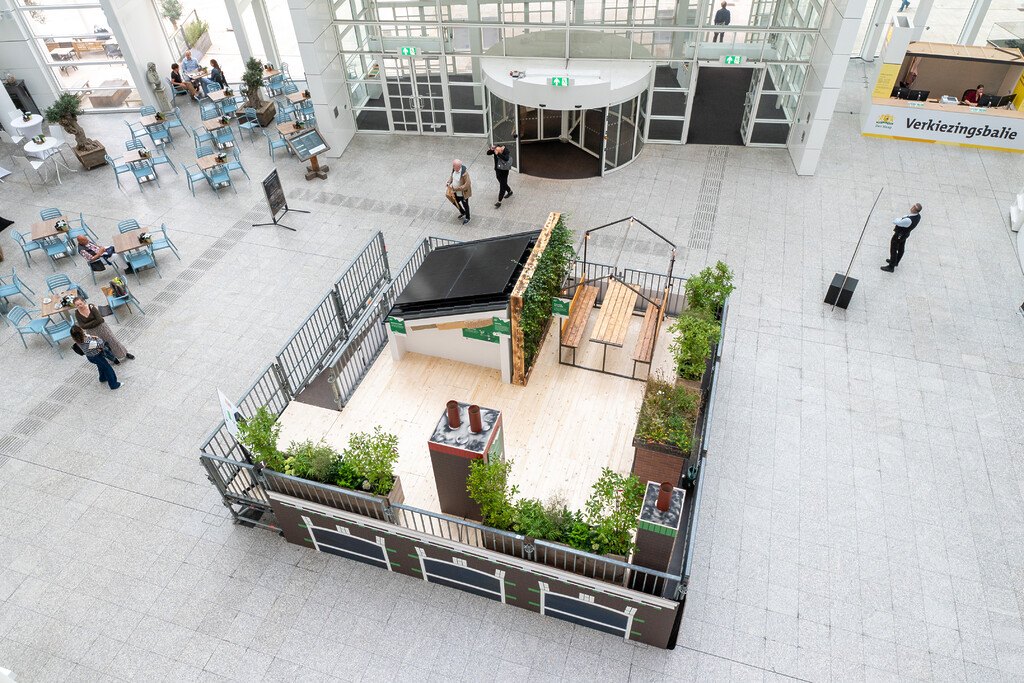
- The former Ministry of Marine building: Solar panels and a shared outdoor area show how one roof can support energy generation and community use.

“The most beautiful green space in The Hague is sometimes not on the ground, but above our heads. By using rooftops more intentionally, we can make the city more pleasant, reduce disruption from heat and rain, and make better use of existing buildings. It is a practical and efficient way to prepare The Hague for the future. The City Hall sets an example and shows how much potential our rooftops hold.”
Isabelle Broeders, Deputy Mayor for Public Spaces, Energy Transition and Regional Cooperation
A city-wide rooftop strategy
Around 35% of suitable roofs in The Hague are already used for solar panels, green roofs, or rainwater storage. The city aims to increase this to at least 50% by 2030.
The municipality is also using its own buildings to demonstrate the approach. Its programme includes 5,200 square metres of green roofs across The Hague City Hall, the Central Library, and the Forum office complex. These roofs store rainwater, provide cooling, and create habitats for plants and animals.