International Court of Justice to receive Carnegie Wateler Peace Prize
Carnegie Wateler Peace Prize recognises the Court’s role in settling disputes between countries as it marks its 80th anniversary.


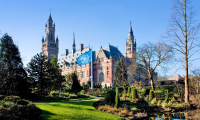
The International Court of Justice (ICJ) will receive the 2026 Carnegie Wateler Peace Prize at the Peace Palace in The Hague on 9 November. The award recognises the Court’s contribution to resolving disputes between countries through international law. It comes as the Court marks 80 years since it began its work in 1946.
Resolving disputes through law
As the United Nations’ principal court, the ICJ settles legal disputes submitted by countries and gives advisory opinions on legal questions referred by authorised UN bodies and agencies. Its 15 judges work at the Peace Palace, making it the only principal UN organ based outside New York. Since it began its work, the Court has registered 202 cases. It currently has 24 ongoing cases.
In its jury report, the Carnegie Foundation highlights the Court’s role in providing a peaceful way to resolve disputes amid growing geopolitical tensions. It also recognises the Court’s role in interpreting international law on issues of global importance, including self-determination, international humanitarian law, and the responsibilities of states.

“The 80th anniversary of the International Court of Justice marks not only a historic milestone, but also underscores the enduring importance of the rule of law in international relations. At a time when multilateralism is facing increasing challenges, the Court remains a stable and authoritative pillar of the international legal order. Through its unique combination of judicial authority, peaceful dispute settlement, and contribution to the progressive development of international law, the International Court of Justice plays a vital role in advancing a just and lasting peace.”
Jury Report Carnegie Foundation
The award honours both the judges and the Registry, whose staff support the Court’s work.
A shared commitment in The Hague
Judge Iwasawa Yuji, President of the ICJ, will accept the prize on behalf of the Court and its Registry. Piet Hein Donner, Chair of the Carnegie Foundation, will present it.
The ceremony forms part of a high-level forum organised by the Dutch Ministry of Foreign Affairs, the Municipality of The Hague, and the Carnegie Foundation. Government representatives, international institutions, academics, and diplomats will discuss how international law supports peace, justice, and stability. The gathering will also reaffirm the Netherlands’ and The Hague’s commitment to advancing peace through law.

“The strength of the international legal system does not rest primarily on the Court. States retain the central role. The rule of law depends on a shared commitment by States to respect agreements and to turn to the law when differences arise.”
Judge Iwasawa Yuji at the solemn sitting commemorating the Court's 80th anniversary (April 2026)
A closer look at the Court’s work
To accompany the award, the Peace Palace Visitors Centre is scheduled to host a special exhibition from late October. It explores the Court’s history, how its proceedings work, and the architecture and symbolism of its courtroom, the Great Hall of Justice.
About the Carnegie Wateler Peace Prize
Established by Dutch banker Johan Wateler, the Carnegie Wateler Peace Prize recognises people and organisations that advance international peace through words or actions. The Carnegie Foundation has awarded the prize at the Peace Palace since 1931. This year marks its 75th presentation. Previous recipients include Coretta Scott King, the Permanent Court of Arbitration, War Child, and the Centre for Humanitarian Dialogue.